
You are using an out of date browser. It may not display this or other websites correctly.
You should upgrade or use an alternative browser.
You should upgrade or use an alternative browser.
Solar charge controller - load terminals - what practical use in a MH ?


Admin
Administrator
- Posts
- 6,364
- Likes
- 14,253
Ad Hominem
Ad Hominem comments/personal attacks towards anyone (dead or alive) - is subject to the message being deleted and action being taken against the user, regardless of how pertinent or thoughtful the rest of the message might be.
Forum Etiquette
1. Respect the netiquette: get to know the forum before you post.
2. Do not post negative posts and discussions that are repeated over and over and over with no other purpose than to disrupt the conversation.
3. Do not disrupt multiple threads in order to get your view out.
4. You may not bait/troll members.
5. You may not bait, insult, flame, or otherwise, abuse a staff member.
6. You may not post graphically-disturbing/insulting images.
7. You may not post in a manner that is harmful to the site.
8. You may not post 'discussions/debates' on Wildcamping.co.uk or any part of the company.
9. Do not write in all capital letters, its considered shouting and is quite hard to read.
10. When you ask "what's best", this question cannot always be answered objectively. Each and everyone has their own view about what's best in a certain area. The best is what works best for you!
11. Remain respectful of other members, moderators and administrators at all times.
All posts should be professional and courteous. You have every right to disagree with your fellow community members and explain your perspective, but do it in a respectful and non-dismissive manner.
However, you are not free to attack, degrade, insult, or otherwise belittle them or the quality of this community. It does not matter what title or power you hold in these forums, or if you have paid to be here, you are expected to obey these rules. Doing otherwise will get your account banned temporarily, or permanently if the situation becomes severe enough (this will be left to the discretion of the moderation team). Please remember to stay mature and thoughtful at all times.
If a certain member continues to belittle or use condescending remarks towards other members, then they will no longer be able to post. I am fed up with having to deal with complaints about this member. It is such a shame as this member is really smart, it is a shame that they like talking to others like ****.
Ad Hominem comments/personal attacks towards anyone (dead or alive) - is subject to the message being deleted and action being taken against the user, regardless of how pertinent or thoughtful the rest of the message might be.
Forum Etiquette
1. Respect the netiquette: get to know the forum before you post.
2. Do not post negative posts and discussions that are repeated over and over and over with no other purpose than to disrupt the conversation.
3. Do not disrupt multiple threads in order to get your view out.
4. You may not bait/troll members.
5. You may not bait, insult, flame, or otherwise, abuse a staff member.
6. You may not post graphically-disturbing/insulting images.
7. You may not post in a manner that is harmful to the site.
8. You may not post 'discussions/debates' on Wildcamping.co.uk or any part of the company.
9. Do not write in all capital letters, its considered shouting and is quite hard to read.
10. When you ask "what's best", this question cannot always be answered objectively. Each and everyone has their own view about what's best in a certain area. The best is what works best for you!
11. Remain respectful of other members, moderators and administrators at all times.
All posts should be professional and courteous. You have every right to disagree with your fellow community members and explain your perspective, but do it in a respectful and non-dismissive manner.
However, you are not free to attack, degrade, insult, or otherwise belittle them or the quality of this community. It does not matter what title or power you hold in these forums, or if you have paid to be here, you are expected to obey these rules. Doing otherwise will get your account banned temporarily, or permanently if the situation becomes severe enough (this will be left to the discretion of the moderation team). Please remember to stay mature and thoughtful at all times.
If a certain member continues to belittle or use condescending remarks towards other members, then they will no longer be able to post. I am fed up with having to deal with complaints about this member. It is such a shame as this member is really smart, it is a shame that they like talking to others like ****.
Deleted member 62288
Guest
I'm done with this thread - Many Thanks to everone who contributed.
For me, this thread is closed as Completed and Successful.
I began the thread with a question, which cropped up when I found myself with a free source of power available, courtesy of the Victron MPPT Solar Controller's LOAD terminals.
I was expecting to progress with my other jobs and forget about this function, I had no need of it as I thought that the EBL-100 would be managing both batteries when on solar as it does when on a 220v EHU or when driving.
I briefly explored other uses for the load terminals, perhaps to run the 3x way fridge on 12v, or warm up the water in the tank, but I thought that this function would be redundant.
At the time of the question, I was blissfully unaware that my grand design had an omission.
I was mistaken in my understanding of the Schaudtt Elecktroblok EBL-100.1 functionality.
That omission was, when off-grid and stationary, the EBL ONLY charged the leisure batteries from the solar panels and it completely ignores the engine battery. I had a proper schaudtt solar regulator connected into the correct EBL socket but this only passed around 15A to the leisure batteries and zero to the starter battery.
I also had a low level drain on the starter battery, but no method of re-charging it.
So I replaced the Schaudtt PWM solar controller with a Victron Blue Energy MPPT controller, wired directly to the 2x Victron AGM Super Cycle leisure batteries, 460Ah in total.
Panels are 3x80watt & 1x100watt, up on the roof.
A NASA BM1 battery monitor gives me an insight into the status of the leisure batteries and the engine battery voltage.
I ignored the EBL-100 in this new configuration, as it was a bottleneck when used in the conventional and "normal" way.
The same panels can now be expected to give me a max of around 25Amps in bright sunshine available directly to the batteries.
Whereas the Schaudtt solar controller has a max of 15 Amps to inject into the EBL-100.
That is a huge improvement from the same panels just by upgrading the solar controller.
Here was a potential opportunity to answer my own question by using the MPPT load terminals to keep the engine battery topped up.
I figured that I should be able to end up with 2x solar charging sources configured to properly manage each of the different needs for each the starter battery (95Ah lead acid) and the leisure batteries (460Ah AGM super Cycle).
Part of the reason that I have spent so much time in research, discussion, trial and error, is that I have just invested over £1000 in just 2 new leisure batteries and I needed to ensure that they had the best parenting possible.
I wanted to forget about electric when off-grid and not be limited to 3 or 4 days before being forced to drive, just to get re-charged. I had to up-sticks and drive on 3 or 4 occasions on my last adventure around Iberia, so my intention was to remove this as a limitation, Iberia has plenty of free solar energy - gimme.
The remaining limitations of fresh water and waste disposal are the two main influencers to high-quality "loafing in the sunshine" time now that perpetual free solar is in-service and available for me.
Many of the suggestions made here were based upon switching.
Where you only have one source of charge, albeit alternator, ehu or solar and 2 batteries (leisure and engine), there is a case for a switching arrangement for charging both from the same source.
However the switching route is not appropriate in this instance, because :
A) I Have 2 different battery types to manage, lead-acid and AGM Super Cycle. Each of which have hugely different capacities and different charging needs.
The same source cannot be used by both unless the charging profiles could also be switched.
The source power is supplied by the MPPT controller which is configured for AGM. if I then switch the charging onto a lead-acid battery, it will not be getting the correct charging profile.
B) I have a no-cost spare pair of terminals giving away free solar electric at 14v and 14 Amps, so why wouldn't I use this to charge the engine battery ?
The solution was never going to be no-cost, because I need a bridge of sorts between the source and the battery which had to be a proper charger, preferably configurable for specific battery types.
I eventually settled for the Sterling BB1230 DC to DC charger installed in a non-standard way by using the MPPT load terminals as a source for the BB1230 which uses this to properly manage the starter battery.
I won't get into body politics, but the BB1230 is one ugly beast. But it has performed very well and works perfectly with the Victron MPPT. They work cooperativly in sharing the available solar power to properly charge both batteries independently of each other and each is being charged according to each different needs.
The Schaudtt EBL didn't get an invite to this party, it remains simply to distribute 12v around the van, while off-grid. It's charging functions are not utilised. The standard EBL functionality remains unchanged and are used when driving or on a 220v EHU.
I booted the Sterling on Thursday midday, a dull and grey day with only sparse burst of sunshine breaking through. the panels and the Victron were struggling to scrounge any power.
I also gave the Sterling a knackered starter battery, at 50% depletion, to restore.
Quite a challenge for the new kid on the block.
The afternoon saw the system struggling to make something out of the gloomy light.
The Sterling was getting warm and the cooling fan was cutting in and out for most of the afternoon.
Close of day seen both batteries fully charged.- Success !
Today, Friday started gloomy and improving by mid afternoon with some bright sunshine. More light for the MPPT box to eat.
The Sterling has been silent all day and working happily with the Victron and together they have kept all batteries topped up.
This result is, as I had hoped for, even achieved at such low light levels.
The Sterling probably had the hardest day's work it will ever get, yesterday. Call it an initiation.
Future times should see it only having to maintain an already charged battery, between park ups or long lay-offs.
I intend to reward the Sterling with a new Bosch or Varta engine battery, may they live happily ever after.
----------------------------
The advice, suggestions and comments that have been generated in this thread has been a pleasant and constructive experience which has greatly helped me to arrive at a successful conclusion.
The quality of the inputs and the attention to the details have been of a very high standard. I thank everyone for that, it has helped me to get a result that is looking to exceed my expectations.
And Thank you for the snipers and hecklers, you have been greatly entertaining while at the same time, undermining your own credibility, a feeling called schadenfreude just stroked my Chakras. Thanks again.
Every single proclamation of failure, doom, disaster, etc, has proven to be empty pomposity. Ego, not fact based.
as Sun Szu advises, "Never interrupt your opponent, when they are making a mistake".
Love & Light,
james
Edit / Update Saturday:
I've left time for the system to settle in while I have been keeping a close eye on everything.
I'm more than satisfied with the result, so I did a bit more testing today.
This upgrade has basically ignored the factory fit charging system and is feeding each of the batteries directly and independently of each other.
I have now tested the co-operation of my upgrade with the EBL-100, while on 220V EHU and secondly, when the engine is running.
Everything worked perfectly.
I've already been living full time in the van for the last 3 weeks without the 220v EHU plugged in.
That's all from free solar and my leisure batteries have hardly noticed, now that the engine battery is getting a tan from the sunshine, I can confidently look forward to the PV system providing me with my current daily needs.
I'll be testing a few 220v appliances soon, there are a few things that I would like to use on a regular basis.
NutriBullet for my daily fruit soups, Espresso machine and once a week, a quick go around with the Henry, to clear up after the Jack Russsell has been moulting.
That will obviously deplete the leisure batteries by a lot more than usual but will allow me to give the PV system a bit more work to do.
james
/
For me, this thread is closed as Completed and Successful.
I began the thread with a question, which cropped up when I found myself with a free source of power available, courtesy of the Victron MPPT Solar Controller's LOAD terminals.
I was expecting to progress with my other jobs and forget about this function, I had no need of it as I thought that the EBL-100 would be managing both batteries when on solar as it does when on a 220v EHU or when driving.
I briefly explored other uses for the load terminals, perhaps to run the 3x way fridge on 12v, or warm up the water in the tank, but I thought that this function would be redundant.
At the time of the question, I was blissfully unaware that my grand design had an omission.
I was mistaken in my understanding of the Schaudtt Elecktroblok EBL-100.1 functionality.
That omission was, when off-grid and stationary, the EBL ONLY charged the leisure batteries from the solar panels and it completely ignores the engine battery. I had a proper schaudtt solar regulator connected into the correct EBL socket but this only passed around 15A to the leisure batteries and zero to the starter battery.
I also had a low level drain on the starter battery, but no method of re-charging it.
So I replaced the Schaudtt PWM solar controller with a Victron Blue Energy MPPT controller, wired directly to the 2x Victron AGM Super Cycle leisure batteries, 460Ah in total.
Panels are 3x80watt & 1x100watt, up on the roof.
A NASA BM1 battery monitor gives me an insight into the status of the leisure batteries and the engine battery voltage.
I ignored the EBL-100 in this new configuration, as it was a bottleneck when used in the conventional and "normal" way.
The same panels can now be expected to give me a max of around 25Amps in bright sunshine available directly to the batteries.
Whereas the Schaudtt solar controller has a max of 15 Amps to inject into the EBL-100.
That is a huge improvement from the same panels just by upgrading the solar controller.
Here was a potential opportunity to answer my own question by using the MPPT load terminals to keep the engine battery topped up.
I figured that I should be able to end up with 2x solar charging sources configured to properly manage each of the different needs for each the starter battery (95Ah lead acid) and the leisure batteries (460Ah AGM super Cycle).
Part of the reason that I have spent so much time in research, discussion, trial and error, is that I have just invested over £1000 in just 2 new leisure batteries and I needed to ensure that they had the best parenting possible.
I wanted to forget about electric when off-grid and not be limited to 3 or 4 days before being forced to drive, just to get re-charged. I had to up-sticks and drive on 3 or 4 occasions on my last adventure around Iberia, so my intention was to remove this as a limitation, Iberia has plenty of free solar energy - gimme.
The remaining limitations of fresh water and waste disposal are the two main influencers to high-quality "loafing in the sunshine" time now that perpetual free solar is in-service and available for me.
Many of the suggestions made here were based upon switching.
Where you only have one source of charge, albeit alternator, ehu or solar and 2 batteries (leisure and engine), there is a case for a switching arrangement for charging both from the same source.
However the switching route is not appropriate in this instance, because :
A) I Have 2 different battery types to manage, lead-acid and AGM Super Cycle. Each of which have hugely different capacities and different charging needs.
The same source cannot be used by both unless the charging profiles could also be switched.
The source power is supplied by the MPPT controller which is configured for AGM. if I then switch the charging onto a lead-acid battery, it will not be getting the correct charging profile.
B) I have a no-cost spare pair of terminals giving away free solar electric at 14v and 14 Amps, so why wouldn't I use this to charge the engine battery ?
The solution was never going to be no-cost, because I need a bridge of sorts between the source and the battery which had to be a proper charger, preferably configurable for specific battery types.
I eventually settled for the Sterling BB1230 DC to DC charger installed in a non-standard way by using the MPPT load terminals as a source for the BB1230 which uses this to properly manage the starter battery.
I won't get into body politics, but the BB1230 is one ugly beast. But it has performed very well and works perfectly with the Victron MPPT. They work cooperativly in sharing the available solar power to properly charge both batteries independently of each other and each is being charged according to each different needs.
The Schaudtt EBL didn't get an invite to this party, it remains simply to distribute 12v around the van, while off-grid. It's charging functions are not utilised. The standard EBL functionality remains unchanged and are used when driving or on a 220v EHU.
I booted the Sterling on Thursday midday, a dull and grey day with only sparse burst of sunshine breaking through. the panels and the Victron were struggling to scrounge any power.
I also gave the Sterling a knackered starter battery, at 50% depletion, to restore.
Quite a challenge for the new kid on the block.
The afternoon saw the system struggling to make something out of the gloomy light.
The Sterling was getting warm and the cooling fan was cutting in and out for most of the afternoon.
Close of day seen both batteries fully charged.- Success !
Today, Friday started gloomy and improving by mid afternoon with some bright sunshine. More light for the MPPT box to eat.
The Sterling has been silent all day and working happily with the Victron and together they have kept all batteries topped up.
This result is, as I had hoped for, even achieved at such low light levels.
The Sterling probably had the hardest day's work it will ever get, yesterday. Call it an initiation.
Future times should see it only having to maintain an already charged battery, between park ups or long lay-offs.
I intend to reward the Sterling with a new Bosch or Varta engine battery, may they live happily ever after.
----------------------------
The advice, suggestions and comments that have been generated in this thread has been a pleasant and constructive experience which has greatly helped me to arrive at a successful conclusion.
The quality of the inputs and the attention to the details have been of a very high standard. I thank everyone for that, it has helped me to get a result that is looking to exceed my expectations.
And Thank you for the snipers and hecklers, you have been greatly entertaining while at the same time, undermining your own credibility, a feeling called schadenfreude just stroked my Chakras. Thanks again.
Every single proclamation of failure, doom, disaster, etc, has proven to be empty pomposity. Ego, not fact based.
as Sun Szu advises, "Never interrupt your opponent, when they are making a mistake".
Love & Light,
james
Edit / Update Saturday:
I've left time for the system to settle in while I have been keeping a close eye on everything.
I'm more than satisfied with the result, so I did a bit more testing today.
This upgrade has basically ignored the factory fit charging system and is feeding each of the batteries directly and independently of each other.
I have now tested the co-operation of my upgrade with the EBL-100, while on 220V EHU and secondly, when the engine is running.
Everything worked perfectly.
I've already been living full time in the van for the last 3 weeks without the 220v EHU plugged in.
That's all from free solar and my leisure batteries have hardly noticed, now that the engine battery is getting a tan from the sunshine, I can confidently look forward to the PV system providing me with my current daily needs.
I'll be testing a few 220v appliances soon, there are a few things that I would like to use on a regular basis.
NutriBullet for my daily fruit soups, Espresso machine and once a week, a quick go around with the Henry, to clear up after the Jack Russsell has been moulting.
That will obviously deplete the leisure batteries by a lot more than usual but will allow me to give the PV system a bit more work to do.
james
/
Last edited by a moderator:
Deleted member 62288
Guest
I have deleted a couple of posts from this thread because of some name calling.
Please keep this thread on topic.
Sorry Phil and you other dear readers,
I've been baited throughout this thread and today I took a bite.
james
Deleted member 35703
Guest
I for one have enjoyed the read and the journey some extremely good information in the posts and very rewarding
Great thread
Great thread

wildebus
Full Member
- Posts
- 12,179
- Likes
- 17,744
For me, this thread is closed as Completed and Successful.
.....
james
Just a suggestion if I may. Come back to this thread in a few months time - maybe at the end of season and update how things have worked out.
I know quite a few folk questioned my sanity in choosing an AC fridge over the accepted DC 'standard' and I found it has worked as I hoped and in fact more so and maybe even changed a few minds over the sense of spending hundreds of pounds extra for something just because it is for an recreational vehicle as I have updated that thread.
Deleted member 62288
Guest
I for one have enjoyed the read and the journey some extremely good information in the posts and very rewarding
Great thread
The internet and forums such as this one are gold mines of information, and a rich source of data, styles, techniques ,instruction and anyone can access and use any of it.
The ease that we can all access, share and discuss any topic under the sun, is truly amazing if you step back and look at the bigger picture. Cooperative and collaborative efforts will always result in synergy. The more pieces of the jigsaw you can see, then everyone gets to see the bigger picture and make wiser and better informed decisions.
When I was a schoolkid, I was always in the library, this followed me into later life, when I was always reading.
In those days researching a topic was really hard slog.
I was superbly lucky to be part of the teams that built and managed the internet itself.
I was also lucky to be working in a blue chip research lab, when we got some pre-release IBM desktop computers to work on.
We were already using an internal, global data network to use email and document exchanges in the 70's.
Nowadays everyone and anyone can use it and benefit.
We live in interesting times
just a ramble
james
Deleted member 35703
Guest
Yep well said
Deleted member 62288
Guest
Just a suggestion if I may. Come back to this thread in a few months time - maybe at the end of season and update how things have worked out.
I know quite a few folk questioned my sanity in choosing an AC fridge over the accepted DC 'standard' and I found it has worked as I hoped and in fact more so and maybe even changed a few minds over the sense of spending hundreds of pounds extra for something just because it is for an recreational vehicle as I have updated that thread.
I'm not planning on leaving the forum, I enjoy the company here.
I'd be happy to do periodic updates and share the success and failures.
I really know what you mean when folks put down new ideas and concepts. Its a simple fact of life that a large number of people learn the "rules" and blindly quote them as if there are no other alternatives. In my book that is plain dogma.
Dogma has no place in my thinking, Dogma is simply blind faith with no questions.
Mankind would never advance without new ideas and practices, make the mistakes, it's how we learn.
I'm going for a decent PSW Inverter at some near stage and I will try out your approach, I want to use either straight 12v from the solar system or via an inverter to remove the need for lpg. My fridge seems to run better on 220v anyway.
Perhaps we can get a thread going when I start to focus on my installation..
I'm focusing on the supply and distribution right now, I'll be getting to the appliances etc when I'm done with the "heavy" stuff.
I'm grounded right now, unable to travel.
recent events have now given me a rough target date of end August for a time to get back on the road.
I have a lot of electrics to complete and other jobs on the van, while going through the selling of a house and a change of address for me.
So some things will get put on a back burner for a while,
james.
Deleted member 62288
Guest
Test for what?
I'm talking about 4/6mm cables from the battery and so permanent live. And all 4 cables are connected together with a single crimped ring connector so electrically connected.
talking this nest of cabling here
LT-Battery-12V by David, on Flickr
(and as you can see, there is no stud visible left, so can't risk ANOTHER two connecters on top!)
So while I appreciate the reply and suggestion, can't see how it will help, sorry.
(I don't want to take the dash apart and will just stick a resettable breaker on the relevant source feed to remove power - it will loose power to the dash generally, but the tachos are designed to be tamperproof and would do the same if power removed specifically from the Tacho I was advised by a Tacho removal specialist)

I am dreading changing the engine battery through the Hymer letterbox.
I've been in there a few times already, wedged in the golden-rivet position, while trying to fathom *** is this rats nest actually doing, and how ?
I'll upload a couple of pictures, I'll show you what a real rats nest looks like.
edit: must have used a banned expression there.
Deleted member 62288
Guest
You would have thought they would keep some made for the RV/Motorhome/Boat class as everyone says its is growing. Maybe decided they have a different market though but none of that will help here unfortunately. I know my voltronic has the output for lb and starter but you need to get the Duo range for that option.
@ James, when you have charge going in to your leisure batteries does it show on your original control panel? My DT101 does not have an input for the controller like later ones do but it shows whatever voltage is on leisure battery bank and starter battery along with + or - amps on leisure batteries. I 'think' you only get that if you connect through the EBL but interested to know if it can display when not going though like yours is.
Apologies, I never noticed that your reply required a response.
A bit late, but....
The Hymer has a schaudtt DT200 display panel over the hab door.
It can only report what the EBL is seeing at the battery terminals. It reports the correct battery voltages and whatever charging current is going through the EBL-100 internal shunt resistor.
However, I have by-passed the EBL with my solar upgrade so the EBL can see the battery voltages but it cannot see the PV charging current.
The NASA BM1 battery monitor can see the all of the charging current to the aux batteries wherever the voltage originate, (engine/EHU/Solar) as it has it's own shunt located next to the battery bank. It doesn't measure the charging current going to the starter battery, only the voltage.
So I don't have a single place to look, I look at both the DT-200 and the BM1 with some voltage and status info on the front panel of the Sterling BB1230. Not ideal, but workable.
james
Last edited by a moderator:
Deleted member 62288
Guest
Update, 6 months after installation
Update after system has been in daily use for 6 months.
The motorhome has largely been on an EHU since I completed the upgrade in June. I ran on 100% solar for a few weeks of sunny weather in the summer the system exceeded my expectations.
I am now mobile again and have spent most of the last 22 days off the grid, with the exception of a free EHU in Northern Italy (3 days).
There has been little sunshine so far, but I am heading to Iberia where I am expecting lots of bright sunshine on the panels.
The lowest that the aux batteries have fallen to is 75%, with very little solar input, the engine has been maintaining all batteries, usually restoring the max of 105% after half a day of driving.
So, overall I'm happy with the results, very happy.
Many Thanks for all of your various comments, suggestions and help, a great use of a forum.
Loafing about around Tarifa for a while will see plenty of opportunity for the PV system to show it's abilities.
james
Update after system has been in daily use for 6 months.
The motorhome has largely been on an EHU since I completed the upgrade in June. I ran on 100% solar for a few weeks of sunny weather in the summer the system exceeded my expectations.
I am now mobile again and have spent most of the last 22 days off the grid, with the exception of a free EHU in Northern Italy (3 days).
There has been little sunshine so far, but I am heading to Iberia where I am expecting lots of bright sunshine on the panels.
The lowest that the aux batteries have fallen to is 75%, with very little solar input, the engine has been maintaining all batteries, usually restoring the max of 105% after half a day of driving.
So, overall I'm happy with the results, very happy.
Many Thanks for all of your various comments, suggestions and help, a great use of a forum.
Loafing about around Tarifa for a while will see plenty of opportunity for the PV system to show it's abilities.
james

trevskoda
Full Member
- Posts
- 49,164
- Likes
- 74,717
Neither do I, hence the questions posed.
I'm tending towards trickle charging the starter battery via a 12v to 12v charger as I suspect that, by removing the LR1218 Elektroblock unit, I also removed the solar charging of said engine battery.
The next stage is to decide on battery upgrades - which is discussed in an earlier thread of mine on here.
Thanks for the input.
james
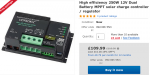
What about this then or two of the other units linked as one for each battery,im now using this and its working well.
Attachments

Deleted member 62288
Guest
Thanks Trev, that is an impressive spec for a very low price. Is it too good to be true ?
Using 2 of these, one for each battery would / could have resolved my initial conundrum, an elegant, simple and cheap solution. A good choice you've made.
Certainly cheaper that what I eventually settled on.
However, This project was completed last summer - the system has worked in excess of my hopes & aspirations. for the last 12 months.
I'm happy that I have both the engine & auxiliary batteries at full capacity from the 3x charging options that I have.
The LOAD terminals of the Victron MPPT controller are connected to the input of a Sterling B2B which is dedicated to only engine battery management - engine battery is a standard lead/acid type. The B2B is configured for lead/acid.
The regular output of the MPPT unit connects directly across the Victron deep cycle AGM's - it does nothing else. The MPPT controller is set to a Gel/AGM charging profile.
I did it this way because the charging profiles required for two different battery types can not be handled by a simple split-charge relay.
This configuration offers me :
A) on 220v ehu, The engine battery is ignored in the standard Hymer factory fit configuration. I now have it being charged from the PV sub-system, using the Sterling B2B.
B) PV system now charges both battery types with a priority on the AUX AGM pair.
C) Engine alternator charges both battery types via the EBL.
AUX batteries are a pair of 230 Ah Victron Deep cycle AGM units, capacity 460 Ah. A pair of these cost me around £1000,
I didn't want to simply use a relay for charge-source switching as this would not give the AGMs a correct charging profile and affect the battery life or performance.
With a split-charge relay, a single battery type is set at the charging unit and shared between battery A and battery B, one of which is always going to be incorrect
Result is unlimited 12v reserve for a system that charges and maintains all batteries, even while off-grid, parked up or in storage.
james
Using 2 of these, one for each battery would / could have resolved my initial conundrum, an elegant, simple and cheap solution. A good choice you've made.
Certainly cheaper that what I eventually settled on.
However, This project was completed last summer - the system has worked in excess of my hopes & aspirations. for the last 12 months.
I'm happy that I have both the engine & auxiliary batteries at full capacity from the 3x charging options that I have.
The LOAD terminals of the Victron MPPT controller are connected to the input of a Sterling B2B which is dedicated to only engine battery management - engine battery is a standard lead/acid type. The B2B is configured for lead/acid.
The regular output of the MPPT unit connects directly across the Victron deep cycle AGM's - it does nothing else. The MPPT controller is set to a Gel/AGM charging profile.
I did it this way because the charging profiles required for two different battery types can not be handled by a simple split-charge relay.
This configuration offers me :
A) on 220v ehu, The engine battery is ignored in the standard Hymer factory fit configuration. I now have it being charged from the PV sub-system, using the Sterling B2B.
B) PV system now charges both battery types with a priority on the AUX AGM pair.
C) Engine alternator charges both battery types via the EBL.
AUX batteries are a pair of 230 Ah Victron Deep cycle AGM units, capacity 460 Ah. A pair of these cost me around £1000,
I didn't want to simply use a relay for charge-source switching as this would not give the AGMs a correct charging profile and affect the battery life or performance.
With a split-charge relay, a single battery type is set at the charging unit and shared between battery A and battery B, one of which is always going to be incorrect
Result is unlimited 12v reserve for a system that charges and maintains all batteries, even while off-grid, parked up or in storage.
james
Last edited by a moderator: