Nordelettronica NE 287 17A charger & changing to Lithium

YeoBlade

Full Member
Posts
2,767
Likes
2,908
I have the above ac charger fitted in my van and am changing the existing AGM battery to a RENOGY Core Series12.8V 300Ah .

The Nordeletronica has Li charge setting @14.6v available so I'll move the dip switches accordingly (But should be 14.4v, I think) but what is a EBC setting for/needed there is nothing connected to it enable disable it ?? Please

Manuals below:

Nord NE287

300ah battery spec
 
I can't see any voltages specified in the manual linked to. Can't see mention of Lithium either.
As far as preferred charge voltage for Lithium, 14.6V is too high and will usually certainly result in a BMS over-voltage error and battery disconnection. 14.4V might be ok but personally I like 14.2V :)
According to the Renogy manual, it will accept upto 15V voltage before a disconnection which is very high for a Lithium (be high for a Lead for that matter) but if the Renogy info is right you can use the charger you have.

Going by the manual linked to, you can set the unit into a "Power Supply" mode which will cause it to output 13.5V. Dubious use as a battery charger on Lithium but it will allow you to plug into an EHU hookup without knocking out the battery, but I would recommend you need a new charger.
 
Where have you got the Nord charge voltage figures from Julian? I can't see anything in the info you linked to?
Assuming the BMS tolerates the upper charge voltage which according to their literature it will, what I'd do personally is this.
Fully charge the lithium battery, let it stand for a couple of hours and then measure it's resting fully charged voltage. Let's take 13.5v as an example.
Look at the Nord profile info and see if you can choose a charge profile which has a float voltage setting that's slightly lower than 13.5v, It'll probably be the flooded lead acid setting. Doing this will ensure the lifepo4 battery doesn't sit being float charged. The actual voltages produced by chargers can be inaccurate so best to check the actual float voltage output with your meter.
The EBC on the Nord chargers is an option which applies a desulphation charge. It shouldn't be used with lithium anyway so if you've got the required signal terminal connected to the charger you should remove it and/or make sure it's not toggled on.
Having said all of the above long term tests show that the harm done to Lifepo4 by floating is actually very small. If you leave it floating at a high voltage for months and months on end you'll probably start to reduce its capacity slightly but if you only float it for a few hours every so often the 'harm' is actually insignificant. For instance floating at 16V (yes 16V not a misprint!) for 10,000 hours causes about 12% loss of capacity.
I've changed to lithium a while back but retained my Nord charger for the reasons above.
 
Ooops should of said LiFePO4 for the new battery.

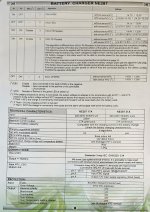
And the Nordelec manual online, I see is slightly different from the one in print I have with me, which has a DIP switch setting of OFF ON , which gives 14.6v / 13.8v

Nord.jpg


Page 12 of the Renogy Battery manual shows 12.4v charge.
 

Attachments

  • 16784.jpg
    16784.jpg
    555.5 KB · Views: 41
Oh and a big thankyou to who recommended this great little meter, my other gear will be collecting dust now.
KAIWEETS Clamp Meter DC/AC KC604 Clamp Meter
 
Yep, third one down looks promising. Flooded lead acid WITHOUT the EBC.👍
Check the actual voltages you get Julian but personally the flooded LA without EBC looks better than the lithium settings that Nord have chosen.
 
Great that's the mains Charger sorted,

Fortunately the Solar MPPT Epever I have is fuller user programable so that will be Ok. (When the sun does appear!)

Next it's the Nordelec DC-DC fitted, hidden under the drivers seat that my well have similar profiles to the mains charger to check, I've read the drivers seat needs to be removed to get to the underside of it where the DIP switches are !!

Check the actual voltages you get Julian but personally the flooded LA without EBC looks better than the lithium settings that Nord have chosen.
I will, it is arriving today so may fit it tomorrow and monitor it.

I find it interesting that the manufacturer is able to provide a charge profile that is then not appropriate! Confusing or what?
 
I find it interesting that the manufacturer is able to provide a charge profile that is then not appropriate! Confusing or what?
I've said it before, lithium isn't fussy about settling. We see people and companies recommending very precise voltages around the 14.2 volt mark but just 13.7 v will get the battery charged to over 95% with the last few % going in slowly. Anything above 13.8v isn't worth arguing about WRT charge percentage/time. As I already mentioned I've seen a research paper that charged to 16V and kept them.floating at 16V for two years and IIRC they lost just 30% capacity. The only caveat to that statement relates to how the battery's BMS does it's top balancing equalisation, because some BMSs are attempting to equalise constantly (the best IMHO) while some don't start top balancing until a certain voltage is reached and this could well be 14v or more. So obviously if you have the latter AND you only ever charge to 13.9v then the cells never get top balanced. Lead acid profiles are always well above 14V though there's usually a LA setting that's perfectly useable.
 
Another thing I have found out, now, is that Mobilvetta put TWO of these Nordelettronica NE 287 17A charger/power supplies in.

The one right next to the L Battery is, a power supply for the (12V) underfloor heating 🤔.

And, Under drivers seat sits the other one which IS the charger and there is also the DC-DC charger there too.

I couldn't figure out with the voltages present what was going on as all the wiring disappears and is hard to trace without removing more panels
 
Another thing I have found out, now, is that Mobilvetta put TWO of these Nordelettronica NE 287 17A charger/power supplies in.

The one right next to the L Battery is, a power supply for the (12V) underfloor heating 🤔.

And, Under drivers seat sits the other one which IS the charger and there is also the DC-DC charger there too.

I couldn't figure out with the voltages present what was going on as all the wiring disappears and is hard to trace without removing more panels
That's interesting, it suggests that you cant use the underfloor heating unless you're on EHU....must be running on 12V and be relatively low power heating mat?
A word of caution about the Nord chargers. I don't know how hot the 17A units you have get but I have the 20A version and I've had to repair
It twice, the second time due to excessive heat build up when supplying high currents for a long period of time. The PCB tracks get hot as does the inbuilt blade fuse holder and it's wiring. I beefed up the PCB tracks and wiring and fitted an external midi fuse, I also added a cooling fan which Nord also did on their latter units,
I'd probably explore the idea of paralelling both chargers up, use them both to charge the leisure battery and then rewire the UFH into the 12v system and only use it when on hookup. This would give you over 35A charge current from EHU.
There's a trim pot inside them that sets the max charge current too. I actually tweaked mine up to supply over 25A after I'd done the mods to mine.
 
Where have you got the Nord charge voltage figures from Julian? I can't see anything in the info you linked to?
Assuming the BMS tolerates the upper charge voltage which according to their literature it will, what I'd do personally is this.
Fully charge the lithium battery, let it stand for a couple of hours and then measure it's resting fully charged voltage. Let's take 13.5v as an example.
Look at the Nord profile info and see if you can choose a charge profile which has a float voltage setting that's slightly lower than 13.5v, It'll probably be the flooded lead acid setting. Doing this will ensure the lifepo4 battery doesn't sit being float charged. The actual voltages produced by chargers can be inaccurate so best to check the actual float voltage output with your meter.
The EBC on the Nord chargers is an option which applies a desulphation charge. It shouldn't be used with lithium anyway so if you've got the required signal terminal connected to the charger you should remove it and/or make sure it's not toggled on.
Having said all of the above long term tests show that the harm done to Lifepo4 by floating is actually very small. If you leave it floating at a high voltage for months and months on end you'll probably start to reduce its capacity slightly but if you only float it for a few hours every so often the 'harm' is actually insignificant. For instance floating at 16V (yes 16V not a misprint!) for 10,000 hours causes about 12% loss of capacity.
I've changed to lithium a while back but retained my Nord charger for the reasons above.
Hi Meri, the nord charger that you use is it the 287 without the lithium option, if so have you just set it for lead acid as that’s what is in my rollerteam and that is my next step. Also many thanks for the valuable information, much appreciated.👍
Cheers, Cliff
 
Hi Meri, the nord charger that you use is it the 287 without the lithium option, if so have you just set it for lead acid as that’s what is in my rollerteam and that is my next step. Also many thanks for the valuable information, much appreciated.👍
Cheers, Cliff
Mine is the 21A/300W charger not the 17A. I dont know how they differ and my personal settings are meaningless to you because rather than choosing a profile from the front panel i've actually tweaked it internally.
Lithium cells are very tolerant when it comes to charging, anything over 13.6V will get you extremely near to full charge and anything over that will get you to 100% but at lower voltages the last few percentage can take a while to achieve.
All the Nord profiles go well over 14V so you'll be fine WRT charging BUT occasionally some BMSs may be set unusually low and not like the 14.7V bulk charge voltage of the Flooded LA profile and cut out due to reaching the high voltage limit. You wont know until you try it out.
Ideally use the profile with the lowest float voltage, you can test this with a voltmeter at the battery terminals when the battery is fully charged but it's usually the flooded LA setting. Don't leave the battery floating for days and days on end.
Watch out for the fuse, it can get warm because it's carrying 17A continuous and with lithium it'll be carrying the 17A for longer than the LA. Make sure the blades are nice and clean and push it in and out a few times to make sure the claws are tarnish free, the 'bite' should be nice and tight, cheap fuses often have slightly thinner blades and are a sloppy fit and not good enough IMO.
 

Users who viewed this discussion (Total:8)

Back
Top