CHARGING DELTA2 FROM MOTORHOME SOLAR PANEL.

Mtbcol

Full Member
Posts
394
Likes
268
Lookout it's me again 😁.

I'm going to supplement our lead acid leisure battery with our ecoflow delta 2. The leisure battery is currently hooked up to my victron mppt.

Once the LB is fully charged when we're parked up, if the delta 2 needs topping up I plan to disconnect the solar panel from the mppt ( I've got MP4 connectors before the mppt and also plan to put in a breaker as it will be easier) then connect the panel to the DELTA2 with the appropriate leads. Do I need to disconnect the mppt from the LB each time I do this, and does it matter what order I disconnect in if I do need to. I know on initial set up you don't in a particular order.

This is only a temporary set up as once funds allow again I'll be replacing the lead acid LB with a lithium.

Thank you.

Colin🙂......⚡⚡💥😁
 
Loads of options from an Alternator charger to the EcoFlow or a fused XT60 off the battery to the EcoFlow (will charge while driving) or an additional portable solar panel to the EcoFlow.

I charge my Delta 2 Max (and extra batteries) from an Alternator charger while driving and I also have 2 fold out 220w solar panels.

I also run 460ah Fogstar Lithium, but lucky for you you don’t have my misses (can come to a deal mind)

I do have 2 x 100ah Lithium batteries to sell if your interested btw
 
Do I need to disconnect the mppt from the LB each time I do this, and does it matter what order I disconnect in if I do need to. I know on initial set up you don't in a particular order.
If you are disconnecting the panel from the controller and feeding this direct into the Delta(or via another controller), then leave the controller connected to the leisure battery.
The leisure battery should always be the first thing connected, and last thing disconnected.
 
Probably a better option you can get a solar panel to stand outside , connect to power station you will get more solar harvest pointing solar panel to the sun 100 w etfe semi flexible about £ 65 from battery group Barnsley ,you will also need solar extension lead , I use a folding 200 w with stand and case from Hampshire Hampshire generators £200.
 
Last edited:
While I have 2 x solar panels for my Jackery, I now charge/top up Jackery using the 2000w inverter, which of course is wired to LB’s and are charged by 2 x panel on MH roof.
 
In your application I think I would be looking at a battery 1/ battery 2 type switch. Just flick the switch from tab battery to whatever you connect to battery 2, in this case the Delta 2.

I just turn on my inverter and plug the Delta 2 into that to top it up but my way means you need to remember and watch you don't take too much out the hat battery
 
In your application I think I would be looking at a battery 1/ battery 2 type switch. Just flick the switch from tab battery to whatever you connect to battery 2, in this case the Delta 2.

I just turn on my inverter and plug the Delta 2 into that to top it up but my way means you need to remember and watch you don't take too much out the hat battery
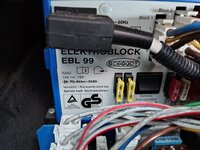
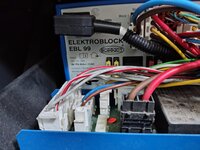
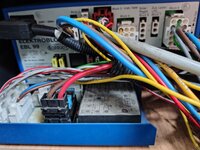
Another great idea, thank you. I've also made up a lead that plugs into my ehu socket on the MH and that I can plug into the DELTA2 to power the 240 volt sockets in the MH. I read somewhere that I need to switch something off on the electro block under the passenger seat, or it would drain the delta by trying to charge itself? I'll go outside later and take a photo of my electro block thingy in the hope that someone may be able to tell me what to switch off or disconnect in this scenario. I'll only be using this set up temporarily and when we're "off grid" for a day or so. 🙂
 
My post was a late post, what I didn’t add is the following. 2000w inverter is wired up to two type house sockets, also, inverter has a separate on/off switch on the outside seating area where the inverter and all electrics are located with the LB’s. No requirement to lifts seating when I want the inverter on. And of course the Jackery transformer is always plugged in, with the male socket plugged into Jackery itself.

I try to leave charging when I am in the move, but if in warmer climes, MH solar panels keep LB’s topped, even with the inverter on. I now have 2400 VITOMAN power bank, I don’t plan to buy solar panels, will be charged/topped up using tge above method.
 
. I read somewhere that I need to switch something off on the electro block under the passenger seat, or it would drain the delta by trying to charge itself?
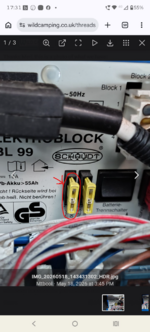
You need to turn off the mains charger. Assuming it's the 99, pull the fuse labeled Internes Lademodul which according to Chatty Pete is fuse 1 on the left, 20A or you can disconnect the charger by pulling the IEC plug where the charger plugs into the main box.
 
You need to turn off the mains charger. Assuming it's the 99, pull the fuse labeled Internes Lademodul which according to Chatty Pete is fuse 1 on the left, 20A or you can disconnect the charger by pulling the IEC plug where the charger plugs into the main box.
Thanks Merl, this is a photo of what we have:
 

Attachments

  • IMG_20260518_143431302_HDR.jpg
    IMG_20260518_143431302_HDR.jpg
    304.9 KB · Views: 6
  • IMG_20260518_143405575_HDR.jpg
    IMG_20260518_143405575_HDR.jpg
    353.3 KB · Views: 10
  • IMG_20260518_143411609_HDR.jpg
    IMG_20260518_143411609_HDR.jpg
    365.9 KB · Views: 7
Either pull that left hand yellow fuse or the mains lead whichever is easiest for you to kill the mains charger
 
In response to the PM i received and direct from EcoFlow site :-

It depends on your priority: fast charging is better for convenience, while slow charging is better for maximizing battery lifespan. [1]

Fast Charging
  • Pros: Charges your EcoFlow unit from 0% to 80% in under an hour using their X-Stream technology. Perfect for emergencies or getting on the road quickly.
  • Cons: Generates higher internal heat and runs the internal cooling fans, which causes a bit more wear on the battery cells and can degrade overall capacity slightly faster over thousands of cycles.
  • Best used for: Day trips, unexpected power outages, or whenever time is of the essence. [1, 2, 3, 4, 5]

Slow Charging
  • Pros: Generates significantly less heat, putting less chemical and thermal stress on the battery. It also draws fewer watts, preventing you from tripping household circuit breakers.
  • Cons: Takes several hours to reach a full charge.
  • Best used for: Overnight charging at home or when you have plenty of time to spare. [1, 2, 3, 4]

The Best Approach
EcoFlow uses highly durable LiFePO4 (LFP) batteries in most of their modern portable stations (like the Delta and River series), which are designed to withstand heavy use. Because heat is the primary enemy of any lithium battery, using the EcoFlow app to manually lower the AC charging speed to around 400W–500W is the most recommended best practice for everyday home use. [1, 2, 3, 4]
Top Tip: Reserve the maximum fast charging speed for emergencies and use the slower charge setting for your daily routine. For detailed charging speeds for your specific unit, check the EcoFlow Official Blog on battery care. [1]
 
I`ve seen 180w on the EcoFlow display when i angled the panel as square as i could to the sun on a cloudless day :cool:

Having said that the EcoFlow display could be wrong as well :unsure:

It`s extremely well made IMHO, permanantly fixed to the shed roof with MC4 connectors already attached so was simple to feed them through a hole in the shed and connect to the XT60i cable then direct into the EcoFlow that sits on a raised shelf.

Each time it's used on a day trip i'll pop it back on charge in the shed to top it up and it doesn't really matter if it takes a while.

For my use it was a very good reasonably priced product that works great for me.
 
Back
Top