Whale submersible pump (881) problem

Holasuki

Full Member
Posts
190
Likes
56
Hi folks
I was about to drain down my van ready for hibernation when I found the above pump had stopped working. Checked fuses, pump seems connected ok, red light comes on at the switch but no power / noise coming from the pump.
Any ideas before I go and buy a new one - if so, should I replace like for like?
Cheers.
Suki
 
As said above I also fitted a pressure switch rather than rely on the tap switchs which where a bit iffy. I also fitted a larger pump made better pressure for the shower and taps down side water usage is up
 
Get a pin or thin nail through the inlet hole in the base of the pump and turn the impeller round a couple of turns by hand. Some pumps have a clip on/off plastic mesh which may need to be removed first in order to gain access.
 
the pump has a 2 core wire coming from it and will go to a connection somewhere nearby,usually a bit of terminal block or a switch.set the meter dial to volts DC and put the probes into the connection so they are each touching a screw or bare wire. if you get a reading of 12v or more ,then pull out the pump and replace with one with a similar pressure -PSI ,which should be printed on the pump body

don't be scared as 12v won't kill you,and if you mess up then you may blow a fuse,no big deal!
 
Last edited:
Thanks for that. Your encouraging words have given me fresh determination.

It doesn't help that my van is parked on my my old mum's driveway on the other side of town - I live in a flat in a quiet little close with nowhere to keep it. I keep checking the weather forecast praying the temperatures don't drop before I can get the residual water out of the pipes. Luckily, It's been quite mild so far up north. :0)
 
I'm sure this is correct, but when our pump started to leak we took it apart and resealed it, (had also been noisy before), it still had a very slight leak, but inadvertently we left the pump running (dry) for 3 days!!! It is the quietest it has ever been, and no more leaks.:lol-053: (Although I wouldn't recommend anyone trying it). Sorry OP this wont help your problem.
 
Yay!

Just got my head around using the multimeter to check the voltage.
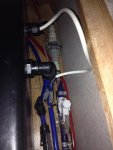
I found the connections, the wire coming from the pump:
image.jpg
Then disconnected the wires:
image.jpg
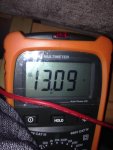
Put the multimeter terminals in and took the reading:
image.jpg

So it appears the pump has had it (gave it a clean but no joy).
And though I need to buy a new pump, I'm feeling quite chuffed with myself for getting my head around it, thanks to you guys.
Not only that, I've (hopefully) managed to insert photos for the first time.
:cool1:

Suki.
 

Attachments

  • image.jpg
    image.jpg
    47.8 KB · Views: 150
in that last pic,the white thing on the right is a pressure switch,so you won't need a micro switch to operate the pump
 
better explain how it works-
when the pump is operated,water is fed from the pump,through the pressure switch, to the tap.
when you turn off the tap,the pump carries on for a few seconds causing pressure to build up in the pipework.
the pressure switch senses this pressure,and causes a microswitch to open,turning off the pump.
as long as that pressure build up remains,the switch remains open.
as soon as you turn on a tap,the pressure is released and the switch closes,turning on the pump-and so on
in the system there should be an override switch to isolate the pump in case of leaks or running low on water,both things will cause the pump to operate,as it can't tell the difference between an open tap and a hole in the pipework
 
Hello Suki,

"Then disconnected the wires"

That is not necessary and can even give a misleading measurement. If the 12v supply has a high resistance in circuit, for example a poorly connected fuse, you will always read 12v with the circuit disconnected but with the load connected this would then give a reduced or even no voltage indicated. To ensure accurate voltage measurement always measure the circuit in question under load.
In all probability it will be the pump that's defective in your case but worth knowing the correct method of testing voltages.

Alec
 
Hello David,

it was not a criticism, but the point is, especially to someone who is new to electrical fault finding, that misleading results can occur given that method.
To expand, a 12v reading is obtained by the method the original poster carried out and there is a high resistance joint somewhere in the circuit. However the diagnoses is that as there is voltage at the pump, so a replacement pump is bought and fitted and it still does not work. Back to square one; done correctly a low or zero voltage reading is found so the next step is to find out why.

It was just a little guidance, and misunderstanding of multimeter use is something I see frequently in Classic Car forums I frequent.

Alec
 
Hi piman
I am going to regret asking this because the reply will likely mash my brain but, when you say 'To ensure accurate voltage measurement always measure the circuit in question under loads', how would a novice like me go about that?

Suki
 
Hello Suki,

to use your current (sorry) problem, simply switch on a tap and that should make the pump run, if it doesn't just measure the voltage at the terminal block where the pump connects. If, as has been suggested, the pump is defective, you will read about 12v at the terminal block but the pump will not be running. If there is no (or low) voltage then you need to try and find out why. I would suggest the first check is the fuse. If that is good then try a different tap or taps.

Alec
 

Users who viewed this discussion (Total:0)

Back
Top