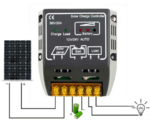
It seems the chap was comparing controllers on a 12V system with a 12V panel and battery at a low state of charge, able to accept all the panel current.
A partial and incomplete test, using a Lithium battery rather than the far more common lead tecnologies..
In this situation either type of controller will probably do a similar job, the PWM type will not be PWM -ing, just connecting the panel straight to the battery.
PWM only starts as the battery begins to approach full charge, when the charge acceptance rate often becomes the limiting factor, not the size of the solar panel. Nor will it be operating the panel at it's maximum power point. Under any circumstance. Just banging the current on and off to modulate the voltage at the battery, subtly or not so much so. Applying a charge profile that may be as basic as just getting the batteries up to 14.3V (measured at the controller output, with or without temperature compensation, and holding them there until the sun goes down.
Better controllers can measure the voltage directly at the battery, compensating for voltage losses down the wiring by taking a little pause every so often to measure it with no current flowing, then compensating when they start up again. Some will even auto-detect what type the battery is, wet, sealed, AGM, gel, Liion, LifePO4 etc, and the voltage/temperature characteristics, and apply a suitable charge profile without requiring you to manually select using e.g. DIP switches or manually entering it on a display panel.
Then doing the same the next morning. I'm not surprised that suppliers refused to send him free controllers for evaluation despite his asking them.
Liion or LiFePO4 batteries may continue to accept charge at a higher rate than lead technologies, depending on the quality of their internal battery management systems. Hopefully the better ones look after themselves irrespective of the type of controller in use. Though they do need a higher voltage to top them off, no they are not simply interchangeable with Lead, unless your charger or controller is specifically designed for them. Then there is the cost. If choosing one of them I'd want to be pretty sure that all that was expensively optimised, wouldn't dream of using a £20 PWM controller. Nor would I on my van, The two new lead batteries (total 180 Ah) cost as much as my 186 W panel plus the MPPT controller that I have nearly chosen, that lot should be fitted in the Spring so can't yet speak from experience.
If you are using lead, trying not to dicharge them below 50%, and the charge acceptance tailing off above say 80%, you might only be getting the full benefit of your panel for 30% of their capacity. Whilst the sun is shining.
Just fitting another big panel may achieve little, other than to boost the bulk charge phase, that's if the batteries can actually accept it. Just because say you can read 14.3 V across them by mid-day on a bright Summers day doesn't mean that they are fully charged by then, that takes quite a few more hours, during which you won't be using the full potential panel output. Adding another one won't force the current in any faster. Meanwhile weighing down the van high-up, and taking up roof space
Having the panels flat on a van roof is not ideal either, if you can somehow angle them more towards the sun, say 30-40 degrees in UK latitudes, the performance increase is significant. Panels are specified at a standard solar insolation level of 1kW/m^2, which is rarely achieved except in parts of the South West.
See
http://contemporaryenergy.co.uk/insolation-map/ for details and study the 10 Year Average Insolation graph.
At the height of Summer a say nominal 100W panel might receive on average 450 Wh in total over a full day, mounted horizontally. About 37.5 Ah for a nominal 12V battery. In reality a lot less by the time it's been through the charge controller then into and out again from the battery.
Whereas in January only 50 Wh (4.2Ah), demonstrating why solar is pretty much pointless here except in Summer.
The MPPT should still do a slightly better job, down-converting the voltage to the battery whilst keeping the panel loaded at it's maximum efficiency voltage.
Yes controllers do fight, except during the bulk charging phase. Connect two in parallel, say you've added another panel, and a second controller because the original was not big enough to run both, and if one thinks that the battery has reached the end of it's absorption charge because the other controller is running at a slightly higher voltage, they are not perfect things , then it will effectively turn off that panel.
Besides, the panel I have chosen is a 24V one that is actually two 12V panels arranged internally with bypass diodes so that if just one cell of one half is shaded or blocked by leaves, dirt, snow, bird poo, the other half continues working. Much like using two separate 12V panels in series, assuming that they do have the necessary bypass diodes inside for this to work. Not all do.
Only an MMPPT controller can do this, i.e operate properly from say notional 12 V or 24 V or higher arrays. They exist for good reasons, and cost more as well, much more going on inside.