Cordless Car Air Compressor Tyre

YeoBlade

Full Member
Posts
2,863
Likes
3,089
I bought one of these a few weeks back from eBay and am really pleased with it. I already had Makita batteries so £28 for the bare unit.
Stated to do 160 PSI, welI I need 80 PSI in the Mohome and it achieved that without problem.
I let all tyres down about 10 PSI and topped then all up to correct pressures on the Motorhome in a few minutes to test the high pressure capability, with little battery usage
The portability of just waking around and connecting to inflate the tyre and handy to keep with you, just in case.

What was more surprising (to me) and others too I expect was the number of tyres that needed to be check from time to time, From Cars, Motorbikes to E-bikes, Ride on mowers trailer, Air suspension and wheelbarrows 😀 including spares I counted 39 wheels to check!
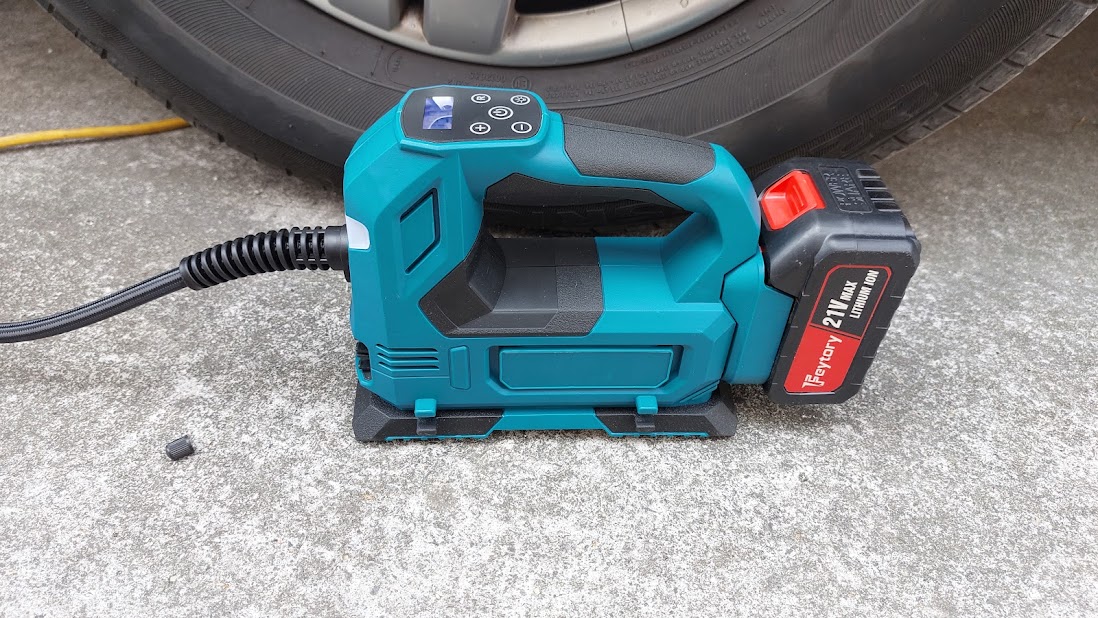
20250701_140152.jpg


1753303265919.png
 
I bought one of these for the motorcycle Julian;


I used it not long ago to top up the tyres on the van, one of which was down to 15 PSI. I was surprised to find that it did the job although it took a few minutes per tyre the battery lasted well.

I carry it in the van all the time now for ease of use but I don't imagine it would last too long if used a lot to maintain high pressures.

The ease of use though is fantastic compared to trailing long leads and hoses around the van so when it gives up the ghost I will go for something like the one you listed.
 
I’ve got one of the Makita type, brilliant bit of kit. I use it to top/check my tyres once a week. My only concern is, now I’m driving a 4500 lump. Is how accurate the reading is?
 
I’ve got one of the Makita type, brilliant bit of kit. I use it to top/check my tyres once a week. My only concern is, now I’m driving a 4500 lump. Is how accurate the reading is?
they're quoted as +-2PSI ,BUT I'd just check with a calibrated source. My vans 4t .
 
I've got the Ryobi version, compressor,torch ,half inch drive rattle gun and a couple of batteries llive in the van.
 
Cant see them being much good or fast, i have a 3cfm mains compressor at home and it can just about do the job after say 3 restarts to get 125psi in the tank before dropping to 65psi and restarting, so im asking what is the cfm of these units, psi has nothing to do with it.
 
Cant see them being much good or fast, i have a 3cfm mains compressor at home and it can just about do the job after say 3 restarts to get 125psi in the tank before dropping to 65psi and restarting, so im asking what is the cfm of these units, psi has nothing to do with it.

It's everything to do with PSI Trev as tyres need inflating to a certain PSI.

My little rechargeable inflator pumps my tyres up to the correct PSI and albeit a bit slower than some pumps it is just as quick really because I don't have to mess about with long cables and hoses. It does the job (and accurately) so obviously has sufficient CFM for it.

It does get warm but not hot.
 
It's everything to do with PSI Trev as tyres need inflating to a certain PSI.

My little rechargeable inflator pumps my tyres up to the correct PSI and albeit a bit slower than some pumps it is just as quick really because I don't have to mess about with long cables and hoses. It does the job (and accurately) so obviously has sufficient CFM for it.

It does get warm but not hot.
Correct but you require a good cfm other wise a tyre may take hrs to inflate rather than 5 mins, remember Rob i had a large ltd company running massif rotery screw compressores in the 200cfm to power 3 chaps spraying and shotblasting, all ran 125psi.
A tyre requiring say 76psi will require at least 3 to 5 cfm to inflate in about 3/5 mins as the aire in the tyre when full will hold maybe 20 cfm after compression to get 75psi.
 
Correct but you require a good cfm other wise a tyre may take hrs to inflate rather than 5 mins, remember Rob i had a large ltd company running massif rotery screw compressores in the 200cfm to power 3 chaps spraying and shotblasting, all ran 125psi.
A tyre requiring say 76psi will require at least 3 to 5 cfm to inflate in about 3/5 mins as the aire in the tyre when full will hold maybe 20 cfm after compression to get 75psi.

That's what I'm saying though Trev, it obviously has enough CFM as it will inflate my van tyres in 3 - 5 minutes.

I haven't tried it from completely flat but from 15 to 64PSI took about that time. If I was completely flat though I would be looking at putting the spare on. This is a great little device for topping up and it is rated up to 150PSI but if that sort of pressure was required I suspect it would overheat.
 
I have one similar to this https://www.sgs-engineering.com/sc150b-150-litre-air-compressor-14cfm sits in its own outhouse behind the workshop so I don’t have to listen to it.

Pipes into the workshop and also to outside the garage, but they are all only as accurate as the gauge, I use a calibrated PCL tyre inflator.

But at higher pressures you have to remember temperature has less effect and accuracy is less important, running an artic +/- 10 psi will mean nothing.

In a race car running at 20psi accuracy is critical.
 
I have one similar to this https://www.sgs-engineering.com/sc150b-150-litre-air-compressor-14cfm sits in its own outhouse behind the workshop so I don’t have to listen to it.

Pipes into the workshop and also to outside the garage, but they are all only as accurate as the gauge, I use a calibrated PCL tyre inflator.

But at higher pressures you have to remember temperature has less effect and accuracy is less important, running an artic +/- 10 psi will mean nothing.

In a race car running at 20psi accuracy is critical.

Bit large to carry in the van though Kev?
 
It's everything to do with PSI Trev as tyres need inflating to a certain PSI.

My little rechargeable inflator pumps my tyres up to the correct PSI and albeit a bit slower than some pumps it is just as quick really because I don't have to mess about with long cables and hoses. It does the job (and accurately) so obviously has sufficient CFM for it.

It does get warm but not hot.
Exactly the point Rob, I've a compressor in the garage and 15 metres of air hose that I can get out BUT, it's a faffle messing about. Walking up to the tyre and clipping on, pressing a button is so easy.
The easier some thing is to do more likely it will be done.
 
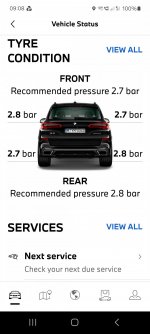
Regarding accuracy it's pretty good, I set it to 2.7 bar, lower each tyre .5 bar And used it to see the results, Which are read on the BMW system, Good enough repeatability for me.
 

Attachments

  • Screenshot_20250801_090854_My BMW.jpg
    Screenshot_20250801_090854_My BMW.jpg
    149.9 KB · Views: 101
I have one similar to this https://www.sgs-engineering.com/sc150b-150-litre-air-compressor-14cfm sits in its own outhouse behind the workshop so I don’t have to listen to it.

Pipes into the workshop and also to outside the garage, but they are all only as accurate as the gauge, I use a calibrated PCL tyre inflator.

But at higher pressures you have to remember temperature has less effect and accuracy is less important, running an artic +/- 10 psi will mean nothing.

In a race car running at 20psi accuracy is critical.
I bought an SGS Engineering Compressor about 8 weeks ago for my nail gun to rebuild 2 fences. Noisy, but 25m air hose got me far enough away from it, and at 5.6 cfm {IIRC], the compressor didn't kick in too often. I use an RAC Ring 900 pump for the M/Home, powered by the vehicle battery; usually have to top up the pressures by 3-5psi before a trip, so about 10 minutes working time and 5 minutes running around the van connecting and disconnecting - so both I and the pump get quite warm and have to be left at rest to cool down ... :ROFLMAO:

Steve
 
But Trev , CFM and PSI are quite different units. like comparing MPH and miles, one a variable/time and the other a unit of distance. The CFM of one of these compressors would be minuscule.
 
That's what I'm saying though Trev, it obviously has enough CFM as it will inflate my van tyres in 3 - 5 minutes.

I haven't tried it from completely flat but from 15 to 64PSI took about that time. If I was completely flat though I would be looking at putting the spare on. This is a great little device for topping up and it is rated up to 150PSI but if that sort of pressure was required I suspect it would overheat.
Thats fast Rob as my tanked 3cfm takes a few runs of the pump to get from say 40/50 psi to 75psi, big pity sellers dont qt the cfm which as you know is important.
Just got me thinking, how many compressed cfm is inside a tyre at say 70psi. :unsure:
 
here you go Trev:

To determine the volume of air at 25 psi, you need to know the starting volume at a reference pressure (like standard atmospheric pressure) and then use the ideal gas law (or a similar formula) to calculate the new volume at the desired pressure. Without a starting volume, it's impossible to calculate the final volume at 25 psi.

Understanding the relationship between pressure and volume:
  • Ideal Gas Law:
    The ideal gas law (PV=nRT) describes the relationship between pressure (P), volume (V), the number of moles of gas (n), the ideal gas constant (R), and temperature (T).
  • Inverse Relationship:
    For a fixed amount of gas at a constant temperature, pressure and volume are inversely proportional. This means that if you increase the pressure, the volume will decrease proportionally, and vice versa.
Steps to calculate volume at a different pressure:
  1. Establish a starting point: You need to know the volume (V1) of air at a known pressure (P1). For example, you might know the volume of a scuba tank at its rated pressure (e.g., 3000 psi).

  2. Apply the ideal gas law (or a similar formula): Since temperature is often assumed constant in these scenarios, you can simplify the ideal gas law. The formula becomes P1V1 = P2V2, where:
    • P1 is the initial pressure
    • V1 is the initial volume
    • P2 is the final pressure (25 psi in your case)
    • V2 is the unknown final volume
  3. Solve for the unknown volume: Rearrange the formula to solve for V2: V2 = (P1 * V1) / P2.
Example:
Let's say you have a scuba tank with a volume of 80 cubic feet at a rated pressure of 3000 psi. To find out how much air is in the tank at 25 psi, you would:
  1. P1 = 3000 psi, V1 = 80 cubic feet, P2 = 25 psi

  2. V2 = (3000 * 80) / 25 = 9600 cubic feet
Therefore, at 25 psi, the volume of air would be 9600 cubic feet (assuming the temperature remains constant).

Important considerations:
  • Temperature:
    The ideal gas law assumes constant temperature. If the temperature changes significantly, you'll need to use the full ideal gas law (PV=nRT) or account for temperature changes in your calculations.
  • Real-world factors:
    The ideal gas law is an approximation. In real-world scenarios, factors like gas compressibility and intermolecular forces can affect the accuracy of the calculation, especially at very high or low pressures.
  • Units:
    Ensure that all units are consistent (e.g., using cubic feet for volume and psi for pressure).
 

Users who viewed this discussion (Total:0)

Back
Top