60kg PAYLOAD

All this talk of weight has got me thinking about my VW T4 camper. As its a PVC and not a conventional motorhome and as it started life as a standard short-nose VW van, then presumably it was designed to carry quite a lot of extra weight anyway so do I need to worry?

I know it's had a section of its roof cut off to accommodate a hi-top - but presumably that wouldn't have made much difference to its basic weight as fibreglass is lighter than metal.

On the gov website it's listing it's revenue weight as 2515KG. Is this the same as the max weight I can have with all my crap in it?

Cheers!
 
OK - Thanks for exploding my mistaken belief that fibreglass is a lightweight material! :) As for its units - not sure what they are made of but it was converted by a conversion company that no longer exists. I bet she's pretty heavy with my underslung water tank full too.

I guess the only way to be sure is to take it to a darn weighbridge.
 
OK - Thanks for exploding my mistaken belief that fibreglass is a lightweight material! :) As for its units - not sure what they are made of but it was converted by a conversion company that no longer exists. I bet she's pretty heavy with my underslung water tank full too.

I guess the only way to be sure is to take it to a darn weighbridge.

DVLA have done some strange things over the years with V5's, so you need to check the data plate on the vehicle and if you are concerned about possible overloading get it weighed fully loaded.
 
All this talk of weight has got me thinking about my VW T4 camper. As its a PVC and not a conventional motorhome and as it started life as a standard short-nose VW van, then presumably it was designed to carry quite a lot of extra weight anyway so do I need to worry?

I know it's had a section of its roof cut off to accommodate a hi-top - but presumably that wouldn't have made much difference to its basic weight as fibreglass is lighter than metal.

On the gov website it's listing it's revenue weight as 2515KG. Is this the same as the max weight I can have with all my crap in it?

Cheers!


You need to check the chassis plate for weights.
Like most van models, there are various weight options within what look like identical vehicles.
A T4 could be a 800, a 1000, and in LWB a 1200. These numbers relate to a difference in carrying capacity.

Chassis plate will reveal all. Well, nearly all. :)
 
Certainly causes a lot of confusion, but nearly always the info is within the numbers that follow the model name. Somewhere your model will be referred to as a 1.9TD 3.1 or something similar.

All down to money, theres a few £1000 between a, lets say a 3000GVW model and a 3500GVW model

(Assuming the plate is the original Fiat one, and not a Hymer plate)
 
Last edited:
All this talk of weight has got me thinking about my VW T4 camper. As its a PVC and not a conventional motorhome and as it started life as a standard short-nose VW van, then presumably it was designed to carry quite a lot of extra weight anyway so do I need to worry?

I know it's had a section of its roof cut off to accommodate a hi-top - but presumably that wouldn't have made much difference to its basic weight as fibreglass is lighter than metal.

On the gov website it's listing it's revenue weight as 2515KG. Is this the same as the max weight I can have with all my crap in it?

Cheers!

Hi are there not some weight figures on your log book ? thats where my search started......
 
I see that the wood?? in my Hymer cupboards and partitions in the ML I, is in fact a plywood made with two layers of Balsa and actually extremely light for what it is, it does make you wonder what the UK people who build with MDF or chipboard do, to TRY and bring it down to a lighter weight. As for motorhome worktops, made with Household worktop, that stuff is HEAVY. I did take out both the front seats to do some work and they are incredibly heavy for what they actually are. A class windscreens are also heavy as the size is greater than the standard.
 
Hi are there not some weight figures on your log book ? thats where my search started......

I wasnt at home earlier - I am now home and I found the 'plate'. It has four weights on it - the gross weight is 2515kg and the gross comb. weight is 4000kg then you have a front axle weight of 1280kg and rear axle of 1380kg.

Am i right in thinking that the combo weight is something to do with towing something?
 
Last edited:
I wasnt at home earlier - but I will check the log book when I get home and look for the 'plate' :)

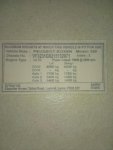
I'm sure you know, But The Plates may look like this if its a van like mine (Peugeot Boxer 320 TD)

IMAG1236.jpg

I've then got another Plate for when The Coachworks & 3rd Axel was Fitted

IMAG1235.jpg

AND yet ANOTHER Plate for when I had the Vehicle UP Weighted Last year via SV TECH (That isn't a plate at all, its a sticky 'Tamper Proof' Sticker. ALL 3 of mine MUST be on show. (I need a bigger Engine Bay !)

IMAG1931.jpg
 
Last edited by a moderator:
I'm sure you know, But The Plates may look like this if its a van like mine (Peugeot Boxer 320 TD)

View attachment 51534

I've then got another Plate for when The Coachworks & 3rd Axel was Fitted

View attachment 51532

AND yet ANOTHER Plate for when I had the Vehicle UP Weighted Last year via SV TECH (That isn't a plate at all, its a sticky 'Tamper Proof' Sticker. ALL 3 of mine MUST be on show. (I need a bigger Engine Bay !)

View attachment 51533

NZ i have a feeling SVTech would rather we did not publish their plating information to prevent copying by scroats......
 
They don't make this Understanding malarkey easy do they lol lol.

I have been on several weigh bridges over the last Year or so, & I ALWAYS have 100% full everything (Gas, Fuel & Water) & a Full Supermarket Shop on board when I do.

I'm running at around the

1650
1300
1150

Mark if memory serves, (i have of course got the exact figures & Axel weights somewhere) but I don't worry about it thease days as I know i have Plenty of Spare Donut n Cider Payload in hand
 
Last edited by a moderator:
Yep I think you may be right. That is how I read it as well. I DONT & will NEVER tow anyway, its a 29ft vehicle as it is. So I preferred to have all the weight allowance added to what I can 'CARRY'. as apposed to saving some for Towing !.
I think the Key thing is the AXEL weights & Ratings in all of this. So technically so long as these are not breached, Maybe I could tow up to there limits !...
 
Last edited by a moderator:
Yep I think you may be right. That is how I read it as well. I DONT & will NEVER tow anyway, its a 29ft vehicle as it is. So I preferred to have all the weight allowance added to what I can 'CARRY'. as apposed to saving some for Towing !.
I think the Key thing is the AXEL weights & Ratings in all of this. So technically so long as these are not breached, Maybe I could tow up to there limits !...

They must have left GTW blank for a reason, even if I can't think of one. I would expect it to be 4500Kg as the previous plate, which highlights another grey area in that you can't work out your towing weight simply by deducting GVW from GTW. So assuming your van plated a 4500kg GVW only weighed in at 3500Kg, that would allow you 1000Kg towing, as long as all the brackets and tow bars were rated at that plate or more. Can of worms :)
 
I wasnt at home earlier - I am now home and I found the 'plate'. It has four weights on it - the gross weight is 2515kg and the gross comb. weight is 4000kg then you have a front axle weight of 1280kg and rear axle of 1380kg.

Am i right in thinking that the combo weight is something to do with towing something?

The way I see that information is
The Vehicle itself MUSTNT EVER weigh more than 2515kg
AND With that 2515kg, The Front Axel MUSNT EVER be heavier than 1280kg & The Rear Axel MUSNT EVER be heavier than 1380kg. IF you can Maintain these Axel Loadings then you may Tow up to a maximum COMBINATION WEIGHT of 4000kg. So that may be in the form of a Braked Trailer weighing in at some 1480kg ish

PLEASE note That is just MY interpretation,,, Not necessarily what it actually means.
 
Isn't it a MINEFIELD ! I'm not so sure it goes on just 'Size of Vehicle' I'm guessing it goes on Make of Vehicle, Tyre Size, Shock Ratings & loads of other good stuff !. Lets be honest about it,,, Keep in mind what a small Landrover can Tow ?.

I think that your actual Vehicle Mustn't weigh more than 3100kg (suitably split over the Axels) & if the axel loads can be maintained then you can Tow 1500kg ish !.
 
Last edited by a moderator:
I wasnt at home earlier - I am now home and I found the 'plate'. It has four weights on it - the gross weight is 2515kg and the gross comb. weight is 4000kg then you have a front axle weight of 1280kg and rear axle of 1380kg.

Am i right in thinking that the combo weight is something to do with towing something?

The gross comb. weight would seem to be the GTW(gross train weight) which is the max combined weight of van and trailer.
 
I wasnt at home earlier - I am now home and I found the 'plate'. It has four weights on it - the gross weight is 2515kg and the gross comb. weight is 4000kg then you have a front axle weight of 1280kg and rear axle of 1380kg.

Am i right in thinking that the combo weight is something to do with towing something?


2515kg is the maximum weight allowed of your vehicle, that includes yourself and passenger if applicable

4000kg is the maximum weight allowed of your vehicle, that includes yourself and passenger if applicable and trailer / caravan when they are connected / hitched.

1280kg is the maximum allowed weight on your front axle, that includes yourself and a passenger if applicable.

1380kg is the maximum allowed weight on your rear axle, that includes yourself and passenger if applicable.

All of the above assumes the vehicle is loaded to the point you would be when you normally travel.


Go to a weighbridge fully loaded or how you normally travel and get it weighed, don``t forget to get back in the vehicle or at least stand on the weighbridge.


If it weighs less than 2515kg :dance: Happy Days :banana:

If it weighs more than 2515kg :scared: Lose Weight :sad:


Apologies for being repetitive but it`s the only way sometimes to avoid confusion :rolleyes2:
 
2515kg is the maximum weight allowed of your vehicle, that includes yourself and passenger if applicable

4000kg is the maximum weight allowed of your vehicle, that includes yourself and passenger if applicable and trailer / caravan when they are connected / hitched.

1280kg is the maximum allowed weight on your front axle, that includes yourself and a passenger if applicable.

1380kg is the maximum allowed weight on your rear axle, that includes yourself and passenger if applicable.

All of the above assumes the vehicle is loaded to the point you would be when you normally travel.


Go to a weighbridge fully loaded or how you normally travel and get it weighed, don``t forget to get back in the vehicle or at least stand on the weighbridge.


If it weighs less than 2515kg :dance: Happy Days :banana:

If it weighs more than 2515kg :scared: Lose Weight :sad:


Apologies for being repetitive but it`s the only way sometimes to avoid confusion :rolleyes2:

surely its 1280 + 1380 = (front plus rear axle figures) 2660 as the maximum weight allowable of both axles combined ?
 
surely its 1280 + 1380 = (front plus rear axle figures) 2660 as the maximum weight allowable of both axles combined ?


That`s not quite how it works, an allowance is made on each axle because you cannot normally load the vehicle to the perfect ratio.
 
That`s not quite how it works, an allowance is made on each axle because you cannot normally load the vehicle to the perfect ratio.


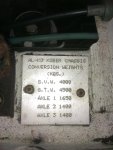
my SV Tech plate says GVW 2600. GTW 3500. Axle 1. 1150 Axle 2 1450. (1150+1450 = 2600) These figures came from Mitsubishi in Japan.

They explained to me that the van could weigh up to 2600 and i could tow an additional 900 .......(3500-2600) AARggh!!!! again !!!! lol
 

Users who viewed this discussion (Total:0)

Back
Top